MAT187 L04 - Polynomial Interpolation
#MAT187 PCE
Polynomial interpolation (Lagrange interpolation) is a method of interpolating between a bunch of points by summing polynomials that intersect one specific data point, and no others. This results in a polynomial that intersects all the data points.
Lagrange interpolation method
For the data points
...where
Example
For a data set with 4 points, the formula is as follows:

...which is basically where the
- A numerator that equals to zero when any
is subbed in. - A constant denominator that divides the numerator such that the result is zero if
is subbed in.
Lagrange interpolation results in a function that:
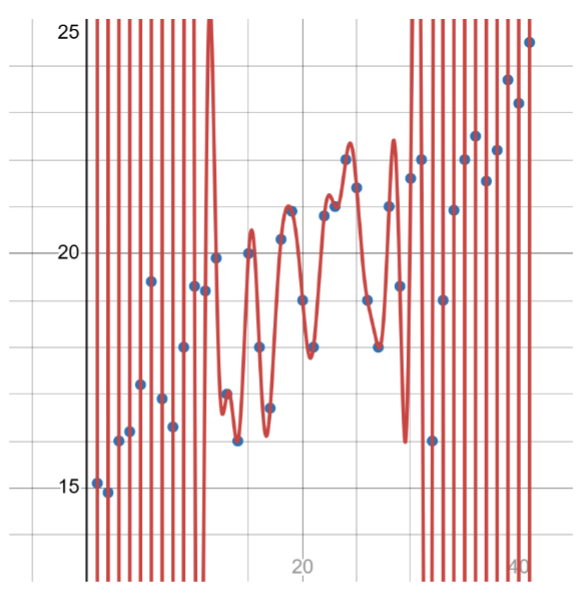
- 100% accurately intersects all data points.
- Does not account for noise in data.
Lagrange Polynomial for 3 data points:
	left=-2; right=6;
    top=5; bottom=-5;
	---
	(1,2)
	(5,4)
	(2,-3)
	y=\frac{2(x-2)(x-5)}{(1-2)(1-5)}+\frac{-3(x-1)(x-5)}{(2-1)(2-5)}+\frac{4(x-1)(x-2)}{(5-1)(5-2)}
Lagrange Polynomial for lots of data points: