MAT187 L17-18 - Trigonometric Substitution
#MAT187 PCE
Recall the following trigonometric identities from high school:
We can use these to our advantage when solving integrals using trigonometric substitution.
To walk through this method, we will use an example, as that is what the PCE does and I don't want to deviate from that.
Identifying Pythagorean Theorem in an Integral
Consider the integral
Then:
Reference Triangle
This is what it would the above would like as a triangle—what the PCE calls a "reference triangle".
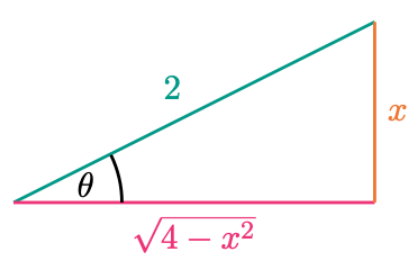
From this, we can identify that:
Substitution and Resubstitution
If you take the derivative of both sides of relationship A) with respect to x, then you get:
...note that this is just a result of implicit differentiation.
So, we can substitute this in for
We can rearrange relationship C) to isolate for
Domain of Trig Sub
Note that since
This makes sense because, for
For other functions, it may not be so cut-and-dry, so you will want to check the bounds every time.
Domains/ranges of common trig functions
You will want to remember these :3
| Function | Domain | Range |
|---|---|---|
| [-1,-1] | ||