MAT187 L21 - Improper Integrals with Unbounded Integrands
Improper Integrals with Unbounded Integrands
Last lecture discussed integrals whose functions become smaller and smaller as they approach infinity, and in some (but not all) of these cases, the integrals are finite as the upper bounds approached infinity.
Now consider a function that approaches infinity as it approaches a specific x-value, such as
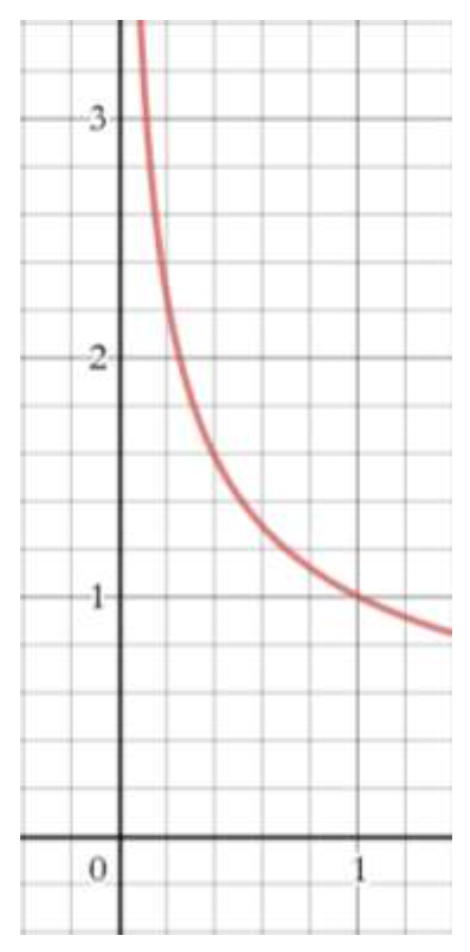
We want to find the integral
For a function
- If the limit exists, we know that the integral converges.
- If it doesn't, we know that the integral diverges.
Common Error: Cancelling Infinities
As with improper integrals with infinite bounds, we cannot simply "cancel" infinities; that is, if we have a function that is symmetric on both sides and approaches infinity when approaching a point from both sides, we can't simply cancel both sides of the function.
Example
Consider the following function:
You absolutely cannot evaluate the integral as normal here, as that would essentially be adding infinities. Instead, use limits.
This results in multiple infinities. This fact in itself is enough to justify divergence.
- Even though we get "negative" infinity and "positive" infinity, we absolutely cannot perform algebra on these infinities. Thus, it diverges.