L18 - Queues and Ordered Linked Lists
queues
Queues are FIFO (First-In, FIrst-Out). Consists of two main functions:
enqueue(): inserts a new node at the end (tail) of the listdequeue(): removes the node that was first added, at the head (front) of the lsit
Unlike a stack, we need to track two pointers - the head and the tail - because we need to remove from the bottom of the list too.
Analogy for Queues (FIFO)
Think of a queue (lineup) for a new GPU drop, pandemic era. First in line (head) gets first dibs on the GPUs, where as last in line (tail) gets last pick. Camp outside Canada Computers nice and early to secure yourself a brand new RTX 3080!
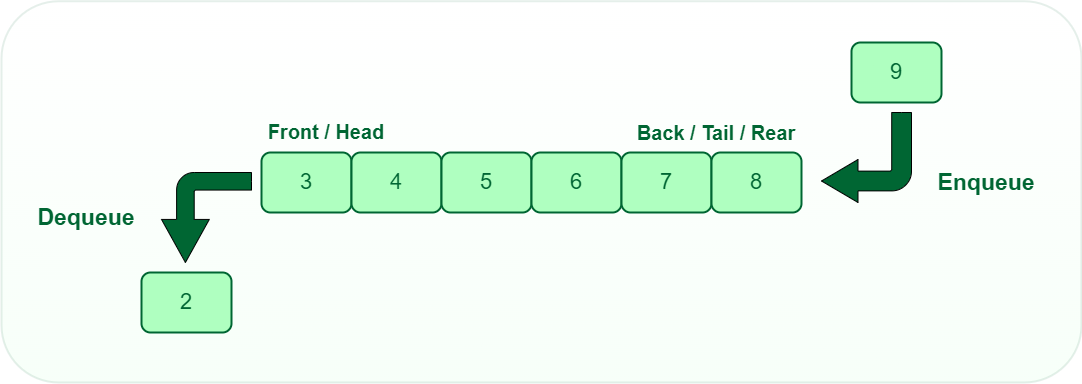
queue class implementation
Note: we are still using the Node class definition from L17.
class Queue {
	private:
		Node *head;
		Node *tail;
	public:
		Queue() {
			// constructor creates NULL head and tail
			// because there are no items in list
			head = NULL;
			tail = NULL;
		}

		~Queue() {
			// destructor is same as Stack; recursively deletes all nodes
			delete head;
		}

		void enqueue(int d) { // add new node to end of list (tail)
			// 1. create a new node, whose 'next' is NULL
			Node *p = new Node(d, NULL);
			// 2. If list is NOT empty (tail exists), link current tail
			// to this node
			if (tail != NULL) {
				tail->setNext(p);
			}
			// 3. update 'tail' pointer to the new node
			tail = p;
			// 4. IF queue is empty previously, then we must also point
			// the head pointer to this new node as well.
			if (head == NULL) {
				head = p;
			}
		}

		int dequeue() { // remove the node at the head and return its value
			// 1. check for empty queue
			if (head == NULL) { // could also check tail == NULL
				return -1;
			}
			// 2. create temp pointer to head
			Node *p = head;
			//3. retrieve data from node that we're removing
			int d = p->getData();
			// 4. reassign head pointer to point to next node in queue
			head = p->getNext();
			// 5. IF head is now NULL (i.e., the queue only had one item)
			// then set both head and tail to NULL bc otherwise tail would
			// point to node we are removing, and then become a dangling ptr
			if (head == NULL) {
				tail = NULL;
			}
			// 6. isolate the pointer we are removing by assigning its next
			// to be NULL
			p->setNext(NULL);
			// 7. delete the isolated node
			delete p;
			// 8. return the data
			return d;
		}
}
example main function using queue implementation
int main(void) {
	Queue q;
	q.enqueue(0);
	q.enqueue(1);
	q.enqueue(2);
	// create queue such that 0 is at head, 1 is in middle, and 2 is at tail

	cout << q.dequeue() << q.dequeue() << endl;
	// prints "012" bc 0 is first in (head), then 1, and 2 is last (tail)
}
ordered linked lists
An ordered linked list is a linked list where the data members are ordered. They contain the following 4 basic operations:
- insert in sorted order
- search
- delete
- copy and
operator=
Thus, they generally follow this class definition. Note: this once again uses theNodedefinition from L17.
#include 'Node.h'

class List {
	private:
		Node* head;
		int data;
	public:
		List() { head = NULL; } // default constructor; set head to NULL
		~List() { delete head; } // destructor; deallocate head node
		void insertData(int d); // insert data into the linked list
		bool dataExists(int d); // search list for data and return bool
		bool deleteData(int d);
		// delete data from list; returns bool for existence of data
		List (const& List); // copy constructor
		List& operator=(const& List); // operator= definition
}
searching linked lists: bool dataExists(int d);
Basic operation:
- iterate through linked list until you find node with value
d - if found, return
true - if you reach the end of the list without finding it, return
false
bool List::dataExists(int d) {

	if (head != NULL) {
		List* curr = head;
		while (curr != NULL && curr->getData() <= d) {
			if (curr->getData() == d) {
				return true;
			}
			curr = curr->getNext();
		}
	}
	return false;
}
Notes:
- we check
curr->getData() <= din the while loop as a time saving measure because then we don't have to check the rest of the list, where the values will 100% not be equal tod(since it's ordered) - technically we don't need the
if (head != NULL)check becausewhile (curr != NULL ...checks that already